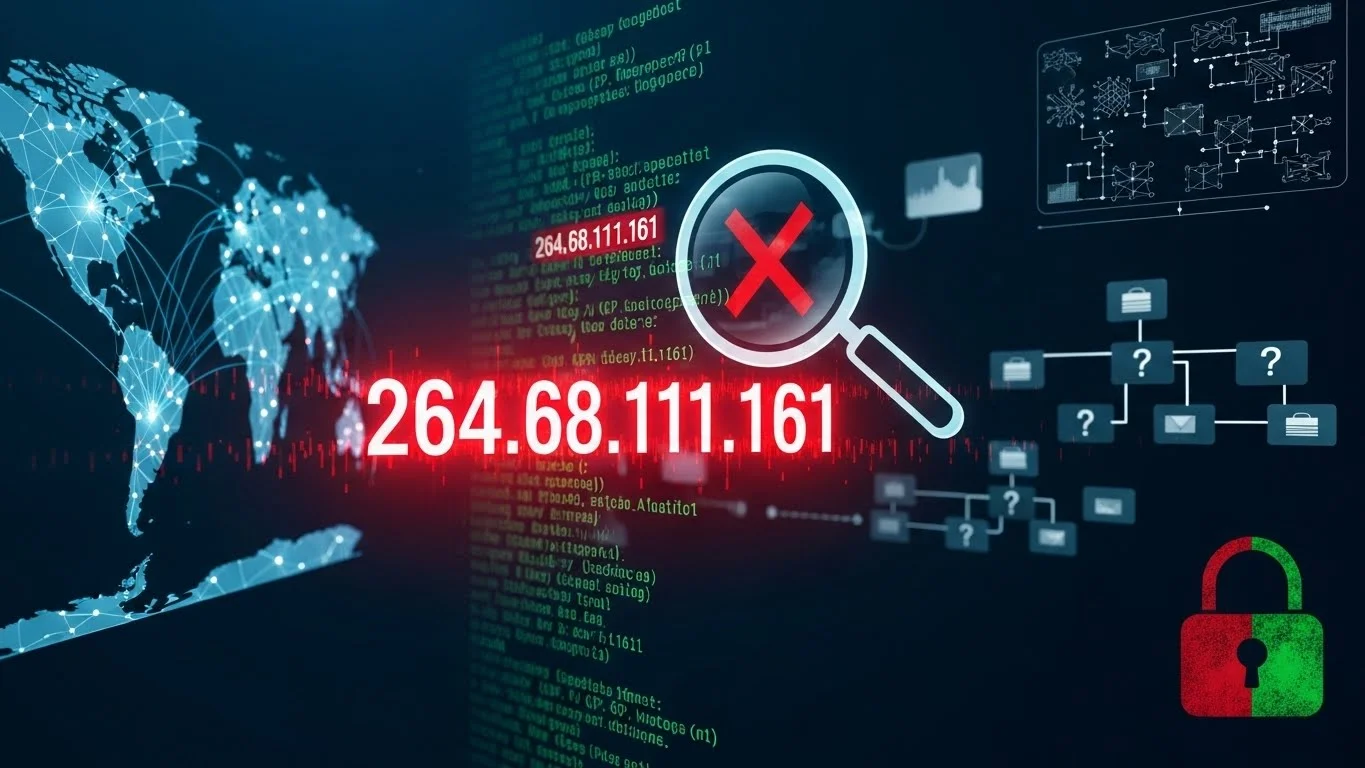

Have you ever seen a number like 264.68.111.161 and wondered what it means? It may look confusing at first. But don’t worry. I will explain everything in a simple way. By the end of this guide, you will clearly understand what this IP address is, how IP addresses work, and whether this one is valid or not.
IP addresses are like home addresses for computers. They help devices talk to each other on the internet. Every time you visit a website, send a message, or watch a video, your device uses an IP address. In this article, we will explore 264.68.111.161, how IP address formats work, common mistakes, and how to check IP validity.
Let’s begin step by step.
What Is an IP Address?
An IP address stands for “Internet Protocol address.” It is a unique number given to each device connected to a network. This could be your phone, laptop, router, or even a smart TV.
Think of it like a postal address. When you send a letter, the post office needs the correct address. In the same way, the internet needs an IP address to send data to the right place.
Most common IP addresses use something called IPv4. These look like four numbers separated by dots. For example: 192.168.1.1. Each number can go from 0 to 255. This rule is very important. We will talk more about this when we discuss 264.68.111.161.
Understanding the Structure of IPv4
IPv4 addresses have four parts. These parts are called “octets.” Each octet must be between 0 and 255. This is because of how binary numbers work in computers.
For example, 192.168.0.1 is valid. Each number is within the allowed range. But if even one part is above 255, the IP address becomes invalid.
Now look at 264.68.111.161. The first number is 264. That is higher than 255. Because of this, it does not follow IPv4 rules. This means it is not a valid IPv4 address.
Understanding this simple rule can help you spot errors quickly.
Is 264.68.111.161 a Valid IP Address?
Let’s answer the main question clearly. No, 264.68.111.161 is not a valid IPv4 address.
Why? Because the first number, 264, is greater than 255. In IPv4 format, each section must be between 0 and 255 only.
Sometimes, people type IP addresses incorrectly. It can happen due to a typo. It can also happen when someone copies data wrongly. In some cases, fake IP addresses are used in spam or test data.
So if you see 264.68.111.161 somewhere, it is likely a mistake or invalid entry.
Why IP Address Ranges Matter
IP address ranges are not random. They are based on binary math. Each octet has 8 bits. Eight bits can represent numbers from 0 to 255 only.
That is why 255 is the maximum number allowed in each part of an IPv4 address. Anything above that, like 264 in 264.68.111.161, breaks the rule.
This system helps keep the internet organized. Without clear limits, devices would not know where to send information.
Understanding this rule is important for students, IT learners, and website owners.
Common Reasons You May See 264.68.111.161
There are a few reasons you might come across 264.68.111.161 online or in logs.
First, it could be a typing mistake. Someone may have meant 246 or 164 instead of 264.
Second, it could be used as a placeholder. Developers sometimes use fake IP addresses in examples.
Third, it could be part of spam or suspicious content. Fake IP addresses are sometimes used to confuse people.
From my experience helping beginners learn networking, small errors like this are very common. Always double-check the format before assuming something is real.
How to Check If an IP Address Is Valid
You can easily check if an IP address is valid.
First, look at the four numbers. Make sure each one is between 0 and 255.
Second, ensure there are exactly four parts separated by dots.
Third, you can use online IP validation tools. Just paste the IP address into the tool, and it will tell you if it is valid.
If you check 264.68.111.161, any validator will mark it as invalid. That is because of the number 264.
This simple method saves time and avoids confusion.
Difference Between IPv4 and IPv6
You may also hear about IPv6. This is a newer version of IP addressing. It looks very different from IPv4.
IPv6 uses letters and numbers. It has eight groups separated by colons. For example: 2001:0db8:85a3:0000:0000:8a2e:0370:7334.
Even in IPv6, numbers follow strict rules. The format must be correct. 264.68.111.161 does not fit IPv6 format either.
So this address does not match IPv4 or IPv6 standards.
Private vs Public IP Addresses
IP addresses can be public or private.
Public IP addresses are used on the internet. Private IP addresses are used inside homes or offices.
For example, 192.168.0.1 is a common private IP address. It helps your router connect devices.
Even private IP addresses must follow the 0–255 rule. That means 264.68.111.161 cannot be private or public. It simply does not fit valid IP address ranges.
Knowing this helps when troubleshooting network issues.
Can an Invalid IP Address Be Dangerous?
An invalid IP address like 264.68.111.161 is not dangerous by itself. It cannot connect to real devices.
However, seeing many invalid IP entries in logs may show errors. It could mean:
-
A broken script
-
A typing mistake
-
Spam attempts
-
Fake form submissions
If you run a website, always check unusual IP logs. From experience, small errors can lead to bigger system problems if ignored.
Stay alert but calm.
How Developers Use Example IP Addresses
Developers and teachers often use sample IP addresses in guides. They usually use special reserved ranges like 192.0.2.0 or 203.0.113.0.
These are safe for examples. They do not connect to real systems.
However, someone may use a random number like 264.68.111.161 as a placeholder. That does not make it real or valid.
If you are writing technical content, always use officially reserved example IP ranges.
Learning Basic Networking Rules
If you are new to networking, start with simple rules:
-
IPv4 has four numbers.
-
Each number must be between 0 and 255.
-
Numbers are separated by dots.
-
No letters allowed in IPv4.
Once you know these basics, spotting errors like 264.68.111.161 becomes easy.
I always tell beginners to practice reading IP addresses daily. After some time, you can quickly see if something looks wrong.
Why Correct IP Formatting Is Important
Correct formatting keeps the internet working smoothly. Servers rely on accurate IP addresses. Routers send data based on these numbers.
If the format is wrong, data will not reach its destination.
Imagine writing the wrong house number on a package. It may never arrive. The same happens online.
That is why understanding why 264.68.111.161 is invalid matters. It teaches you how strict internet rules are.
Small mistakes can cause connection failures.
FAQs About 264.68.111.161
1. Is 264.68.111.161 a real IP address?
No, it is not valid. The number 264 is above 255, which breaks IPv4 rules.
2. Can I ping 264.68.111.161?
No, because it is not a properly formatted IPv4 address.
3. Could it be an IPv6 address?
No. IPv6 uses a completely different format with colons and hexadecimal characters.
4. Why would I see this IP in logs?
It may be a typing mistake, spam entry, or placeholder example.
5. What is the highest number allowed in IPv4?
255 is the highest number allowed in each section.
6. How can I avoid IP formatting mistakes?
Always check each number. Use online IP validation tools if unsure.
Final Thoughts on 264.68.111.161
Now you clearly understand 264.68.111.161. It looks like a normal IP address, but it is not valid. The reason is simple. The number 264 is higher than 255.
Learning small networking rules helps you avoid confusion. It also builds strong technical knowledge.
If you are studying IT, running a website, or just curious, keep learning about IP address validation and internet protocols. These basics are powerful.
Next time you see an IP address, check the numbers carefully. You now have the knowledge to spot mistakes quickly.